LEARN MORE
LEGEND
Discovery of the Original Image
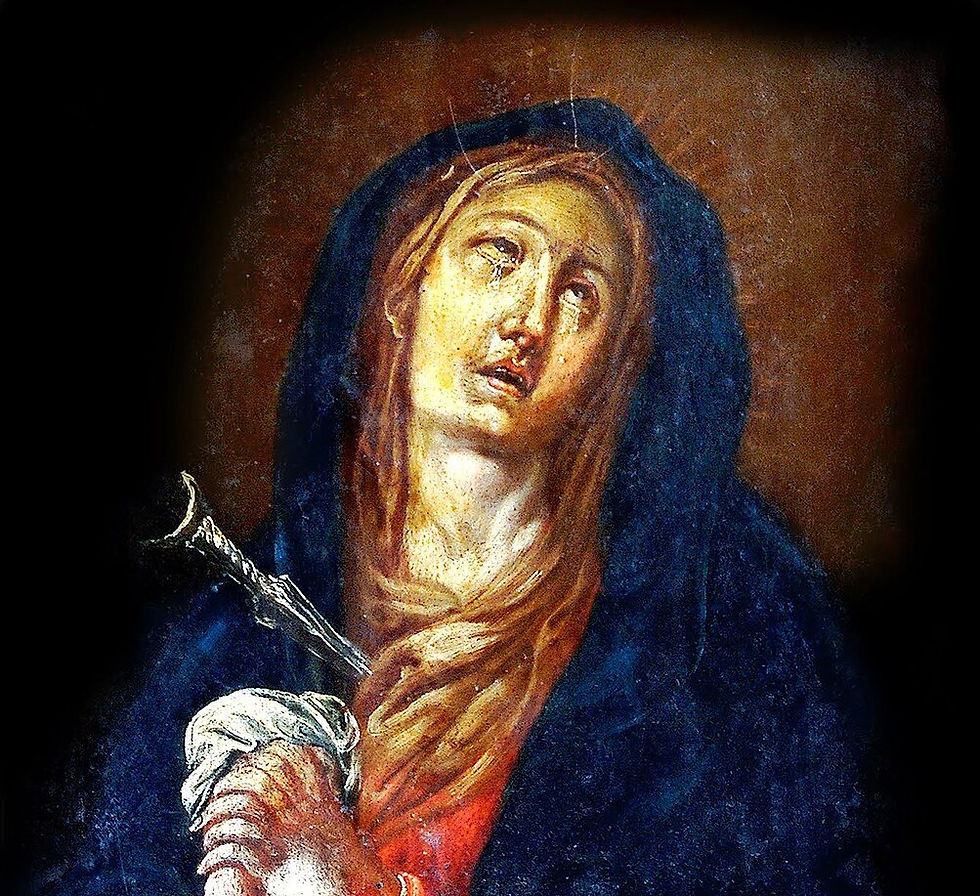
The origin of the Turumba started on one Friday in September of 1788, when local fishermen discovered an oil painting of the Virgin Mary floating on the waters of Laguna de Bay. It was the image of Nuestra Señora de los Dolores (Our Lady of Sorrows).
According to the legend, the fishermen considered bringing the image to a nearby town. However, as they sail, the strong winds
and shifting currents made it difficult to maintain their course.
After struggling, the current eventually carried their boat smoothly toward the shore near the town of Pakil. Upon landing, with the sun beginning to set, they left the image on a rock before departing.


A group of women found the image the following Sunday morning. Despite the rain the previous night, the icon remained miraculously dry. When they tried to move it, the image was heavy and no layperson could lift it. Not even the strongest woman named Mariangga, was able to do so. They then decided to inform the parish priest, Padre Miguel Soriano, who came to the site along with sacristans, choir members, and churchgoers to retrieve the image.
As the congregation lifted the image, the people around began to clap, sing, and dance. To their surprise, the image gave way, and the people continued to prance as it was carried to the church. This miraculous event led the people to commemorate the tradition of Turumba.
This account of the image’s discovery has been passed down through generations and documented in several written sources. It appears in books discussing the history of the Turumba and continues to be told during the celebration of Turumba in Pakil.
Versions of the Legend
There are versions of the legend surrounding the origin of the Turumba.
One account has been recorded by Mr. Iñigo G. Vito.

Iñigo G. Vito
Turumba sa Birhen Maria de los Dolores (1997)
The version of the legend wherein the Turumba began when a group of women danced and sang after discovering the framed image of the Virgin by the seashore. It is said that their clapping and leaping movements made the frame easier to carry, which had initially been too heavy for them.
Other Versions
One version says that although the framed image of the Virgin drifted against the waves, it was still found on the shore the next morning by fishermen resting on a large rock. The story continues that the frame could not be lifted from the wide stone because it was extremely heavy, but when the people began shouting “Sa Birhen!” the frame suddenly became light. From this, they were able to bring the frame to the church.
Another version tells that the framed image of the Virgin was unexpectedly caught in a fishermen’s net. But whenever they tried to carry it to shore to bring to the church, it would slip and fall, making it impossible to lift. When the fishermen eventually reached the shore of Pakil and the children saw the image of the Virgin, they shouted “Sa Birhen!” Because of this, the frame became lighter and the fishermen were able to bring it to the church.
The miraculous day of September 15 is considered the first Turumba in Pakil, Laguna. As time passed, this miracle was followed by many more accounts of wonders attributed to the Virgin of Turumba, shaped by the testimonies of the people of Pakil.
ICONIC IMAGE
Our Lady of Sorrows of Turumba
The iconic image of Nuestra Señora de los Dolores de Turumba (Our Lady of Sorrows) is a portrayal of the Virgin Mary depicted on a 9x11 inches oil painting on canvas.
This Marian image shows the face of the weeping Virgin Mary in deep sorrow, with a dagger pierced directly at her heart. This imagery depicts the seven sufferings of Mary, culminating in Jesus’ sacrifice of His body and soul for the salvation of the humankind.
The original painting is framed in wood and decorated with silver filigree. Today, the framed image is encased in glass and enshrined in a dedicated chapel located on the second floor of San Pedro de Alcantara Parish Church.


The Statue and Its Andas
The story adds that with the persistence of the people of Pakil, and with the help of a highly respected bishop, the original image was brought from Spain, where it was known as Nuestra Señora de las Antiguas.
Since it was better to use a true statue than just a small, framed image for procession, the image from Spain has since been used during Turumba.
The statue is traditionally dressed in somber colors such as violet and black, with red and gold used on special occasions. At times, black cloth is added to enhance the solemnity, while a thin veil may also be placed to soften the overall appearance. The statue is further embellished with necklaces, earrings, pins, and other jewelries, and perfumed with scents donated by devotees.
Its andas (processional carriage) is made of glass and metal and is carried by 36 people during the procession. For protection, the statue of the Virgin is enclosed in a square glass case measuring around five and a half feet on each side. The statue is surrounded by flowers offered by devotees, such as roses, sampaguita, orchids, chrysanthemums, and anthuriums. Traditionally, violet flowers are used, especially during the first Turumba or Biyernes de Dolores.
Today, violet orchids, white dendrobium orchids, and sterling hazel flowers are often prepared for the Virgin. Devotees from nearby towns may take some of these flowers from the carriage, dry the petals, and keep them as personal relics. Some mix the dried petals with oil or hot water as a traditional remedy for minor ailments.

“Pag dinefine kasi natin ang Turumba, maaari siyang mapunta sa iba’t ibang aspeto. Dahil nagbago ang panahon, lumawak na rin ang paggamit ng salitang ‘Turumba.’”
Br. Mac-Lenard Pañoso
Local Resident in Pakil, Laguna
The word ‘Turumba’ is believed to have undergone various interpretations over time. According to the book of Turumba sa Birhen Maria de los Dolores (1997), the term ‘Turumba’ has been interpreted as a state of being out of oneself.
The term ‘Turumba’ is derived from the Spanish-Portuguese word tarum (along with other related variants such as “taruru,” “tururo,” “turum,” or “tarumba”), which refers to a state of being “nahihibang” (delirious), “nawawala sa sarili” (out of oneself), or “hindi alam ang ginagawa sa sobrang tuwa” (acting involuntarily due to overwhelming joy).
ETYMOLOGY
Defining the Word ‘Turumba’

Reference from Vito, I. G. (1997). Turumba sa Birhen de los Dolores: Mga Kwento, Alamat, Kasaysayan, Himala ng Mahal na Birhen ng Hapis. Echanis Press, Inc.
In today’s Turumba, this kind of “loss of self” no longer occurs. But rather, it is the implication of the Filipino phrase "natumba sa laki ng tuwa" or tremble in great joy. During the procession, devotees of the Virgin are mostly seen dancing, jumping, clapping, and becoming fully immersed in dance and celebration with Turumba.