LEARN MORE
RITUALS
Seven Fiestas or Lupi
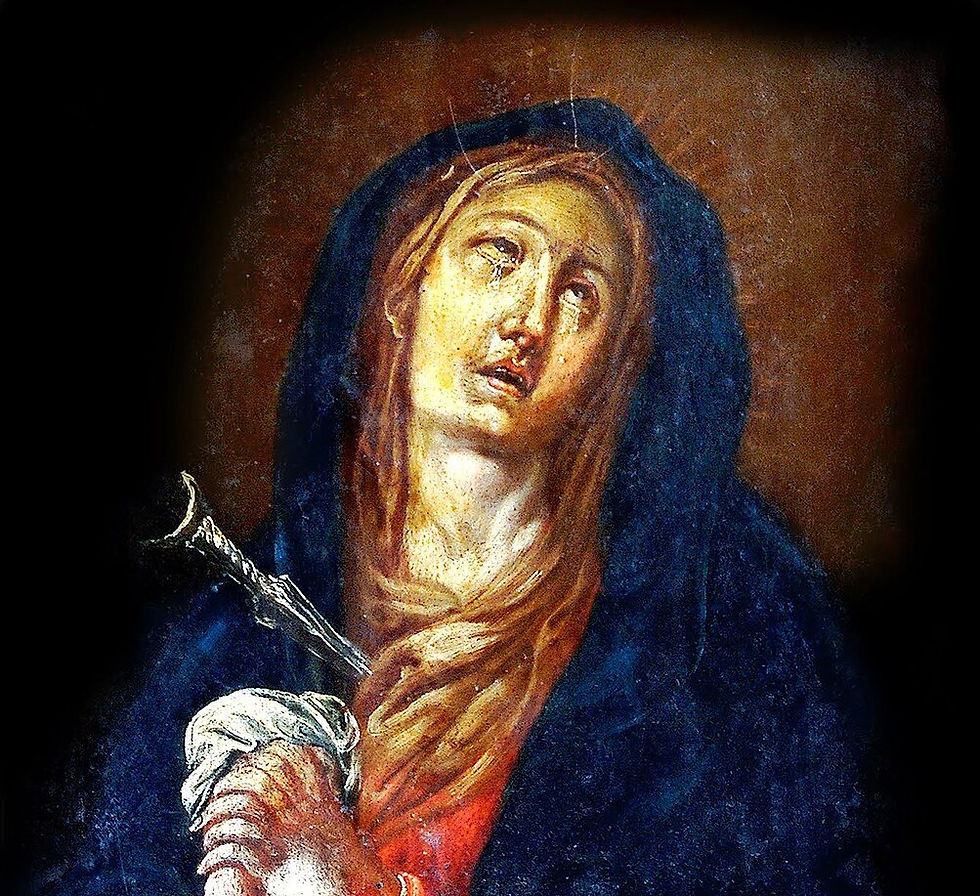
Lupi refers to the novena periods that mark the celebration of the Seven Sorrows of Our Lady of Turumba, symbolized by the seven daggers that pierce her heart. These sorrows are remembered through seven major feast days observed throughout the Lenten and Easter seasons.
In the context of Turumba, the term lupi was defined as a "folding" that signifies the conclusion of one novena cycle and the initiation of another. It refers to the act of ending a novena to celebrate a feast and initiating the next novena cycle for the next feast.

Fig. 2. Turumba Dancers [Picture]. Note. From Turumba Media Ministry, by Turumba Media Ministry, n.d., Facebook. https://www.facebook.com/turumbamediaministry
(1st) Unang Lupi: Biyernes de Dolores
(2nd) Ikalawang Lupi: Piyestang Martes
(3rd) Ikatlong Lupi: Piyestang Biyatiko
(4th) Ikaapat na Lupi: Piyestang Biyernes
(5th) Ikalimang Lupi: Piyestang Linggo
(6th) Ikaanim na Lupi: Piyestang Pag-akyat
(7th) Ikapitong Lupi: Piyestang Pagpanaog
Each of these celebrations commemorates one of the Seven Sorrows of the Virgin Mary:
-
When Mary presented her Son in the temple and heard Simeon’s prophecy of His suffering.
-
When the Holy Family fled to Egypt to protect the Child Jesus from King Herod.
-
When the young Jesus was lost for three days and later found in the temple.
-
When Mary met her Son carrying the Cross to Calvary.
-
When Christ was crucified and died on the Cross.
-
When His lifeless body was taken down from the Cross and laid in Mary’s arms.
-
When Jesus was laid in the tomb.
These seven fiestas or lupi are celebrated yearly, beginning on Friday before Palm Sunday and ending on Pentecost Sunday. These fiestas are well attended by thousands of pilgrims and devotees.
The Turumba procession is held after the last mass of the fiesta. Many miracles are attributed to the loving intercession of Our Lady of Sorrows of Turumba. Due to the growing number of pilgrims and devotees from nearby towns and provinces, additional Lupi fiestas were introduced.
-
Fiesta Pakileña - Celebrated every May 12, this fiesta commemorates the founding of the town of Pakil in 1676. Since it falls within the Lupi period, no separate novena is held.
-
Piyestang Lagunense - This is held on the Saturday before July 16, which is the Feast of Our Lady of Mount Carmel. The province of Laguna was created on July 28, and on July 30, 2016, the image of Our Lady of Sorrows of Turumba was proclaimed “Mother of the Laguna Lake” and “Patroness of Laguna’s Environmental Stewardship.”
-
Piyestang Pagkakaugnay - This is celebrated annually on August 5, which is the Dedication of the Papal Basilica of Saint Mary Major in Rome. The parish of Saint Peter of Alcantara Parish Church in Pakil holds a Spiritual Bond of Affinity with the said Basilica. The other name of the feast refers to the Feast of the Assumption of Mary celebrated the next day.
Domingo de Dolor is the last main feast that is held on September, on the Sunday nearest September 15, the Feast of Our Lady of Sorrows. This feast commemorates the finding of the original icon in 1788.
During this extended season of devotion, countless devotees flock to Pakil to take part in the prayers, processions, and rituals that honor the sorrows and faithfulness of the Blessed Virgin of Turumba.
The Procession
After the Mass, the Turumba procession takes place. Many devotees believe that joining the procession brings healing or spiritual support. The procession is the main event that unites the entire community, with families joining together in a shared expression of faith and joy.
Unlike the usual solemn and orderly processions, the Turumba is characterized by its festive atmosphere. There is no set choreography; people clap, dance, and move freely to the rhythm of the music, often striking their wooden clogs (bakya) together as an expression of joy and thanksgiving. The Turumba procession is inclusive to participants from all age groups within the community. From children to adults, the entire community takes part in honoring the Our Lady of Turumba.

PRACTICE
Pagpapadamit ng Turumba
The tradition of dressing the image of the Virgin (Mahal na Birhen) has long been practiced in Pakil as an act of thanksgiving. Devotees offer new clothes to the Virgin in gratitude for answered prayers — such as recovering from illness, receiving blessings like having a child, passing the bar exams, or achieving milestones.
Many return to the town of Pakil to express their gratitude by sponsoring the Virgin’s clothing. This ritual of dressing the Turumba image reflects the people’s deep faith, devotion, and gratitude to the Blessed Virgin for her intercession.

PERFORMANCE
Reenactment of the Discovery of the Turumba Image
About twenty years ago, the town of Pakil, Laguna revived the reenactment of the discovery of the sacred image of Our Lady of Sorrows in 1788. This event is held every September during Domingo de Dolores as part of the Turumba celebration.
The reenactment shows how the image was found along the shore of Laguna de Bay. Actors play the roles of fishermen and villagers, depicting scenes such as fishing on the lake, catching the sacred image in their nets, and dancing the Turumba in celebration. The people sing the “Awit sa Turumba” with a marching band, and devotees dance as the priest carries the image back to the church.
PILGRIMAGE SITES
Ahunan sa Ping-as
Ahunan sa Ping-as is an annual pilgrimage and community hike held every last Saturday of May in Pakil, Laguna, where residents and devotees climb to the summit of the mountain to attend mass, pray, light candles, and submit their prayer requests.
At its summit stands a large cross and a viewing deck where visitors can look out over rice fields, forested terrain, and Laguna de Bay. From there, people gather for a faith-centered ritual that includes a mass or devotional activity, followed by bathing or drinking from mountain springs that are believed to have healing or purifying qualities.

“Ahunan sa Ping-as” is rooted in the local meaning of ahunan, which refers to the act of climbing or ascending a mountain.
The trail to its summit starts with a paved cement road for a good portion, then leads to a steeper section of stairs before reaching the top where a large concrete cross stands as a landmark. Fronting the shrine are the altars, where the statue of Nuestra Señora de los Dolores de Turumba or simply called Turumba is prominently displayed.
To help visitors learn about its background, marble plaques were placed on the site, each engraved with the history of the mountain. The inscription states:
During the Spanish period around 1671, a Franciscan priest, Fr. Francisco Solier, Kura of Paete, took a vow as a penitent to climb a mountain carrying a wooden cross.
Upon his death, the people of Pakil, out of greath respect, put up a wooden cross in this mountain in front of which they prayed the Holy Rosary and Santacruzan.
In the belief that it cures ailments especially asthma, townsfolks cut out (“Pingas”) small portions of the cross
to use as medicine. The place then came to be known as Pingas.
With the passage of the time, more and more people came to join the mountain climb. Stations of the Cross
were placed along the trail.
In 1966, the Pakil varsitarians constructed a concrete cross at Mt. Pingas. In 1986, the site was bought by the Macabasco Family and donated for the purpose.
In October 1994, the cross was felled by a typhonn. B/Gen. Federico A. Macabasco, Col. Jose G. Hernandez and Councilor Iñigo G. Vito of the Pakil Mountaineers initiated the construction of a 35-foot concrete cross and chapel on the site. These were completed in October 1995 with the generous help of the people and friends of Pakil.
Consecrated on May 25, 1996 by Fr. Zaldy C. Fortuno, Parish Priest of Pakil.
This practice became integrated into the larger Turumba tradition as a way for the faithful to express devotion, seek blessings, and maintain a tangible connection between faith, nature, and communal identity.
Panghulo
The Panghulo (also called the Turumba Spring Resort) is a natural spring and bathing resort area located in Barangay Baño in Pakil, Laguna. Many devotees often visit the pool before going to church, guided by the belief that bathing in its water seven times can bring healing from illnesses.
A local story tells that the image of the Virgin Mary was reportedly seen walking on the water of the spring during a moonlit night. When devotees returned to the church, they noticed the Virgin’s clothes were miraculously wet, despite the image being untouched. Since then, the spring water has been regarded as miraculous.

Coming from a natural spring from the Sierra Madre mountains, the pool draws thousands of pilgrims, especially during the Turumba Festival, who seek its healing properties. Over time, the act of bathing in the Panghulo Pool has become a devotional ritual, performed by many as a gesture of faith and hope for physical or spiritual healing.
For many residents of Pakil, the pool also became a regular venue for swimming practice, where locals honed their skills and developed swimming as a sport. This eventually led to the holding of swimming competitions supported by the local tourism office. Through these activities, the Panghulo Pool grew into a source of livelihood for the community, providing income through sports events, tourism, recreational activities, and related services.
Gallery
Discover the Turumba tradition and practices through the years.
This collection offers a glimpse into its importance as part of the
Turumba devotion.